Engineering concept — in development
The Robot Vacuum That Climbs the Stairs.
Never Stuck Vacuum is a tracked robotic cleaning platform engineered to move between floors, recover from obstacles and keep cleaning — powered by Never Stuck Trax™ mobility. One mobility system. Five purpose-built cleaning platforms.
- Climbs stairs
- Conquers obstacles
- Never stuck
- Pet mess rescue
Ordinary robot vacuums
stop here.
A staircase
Stops. Cleans one floor. Waits to be carried.
Classifies the geometry, articulates the track pods and climbs it.
A thick rug edge
Rides up, loses traction, high-centres.
Senses the slip, re-levels the chassis and drives through on tread.
A phone cable
Wraps it round the brush and shuts down.
Reverses, pivots, modulates the tracks and takes another line.
A raised threshold
Wedges. Reports an error. Sits there.
Escalates through a staged recovery sequence until it is moving again.
Behaviours described here are engineering targets for the Never Stuck Trax™ mobility platform, not measured performance figures.
One mobility system.
Multiple cleaning missions.
- HOME
Never Stuck Vacuum Home
Core residential
Everyday cleaning that does not end at the bottom step.
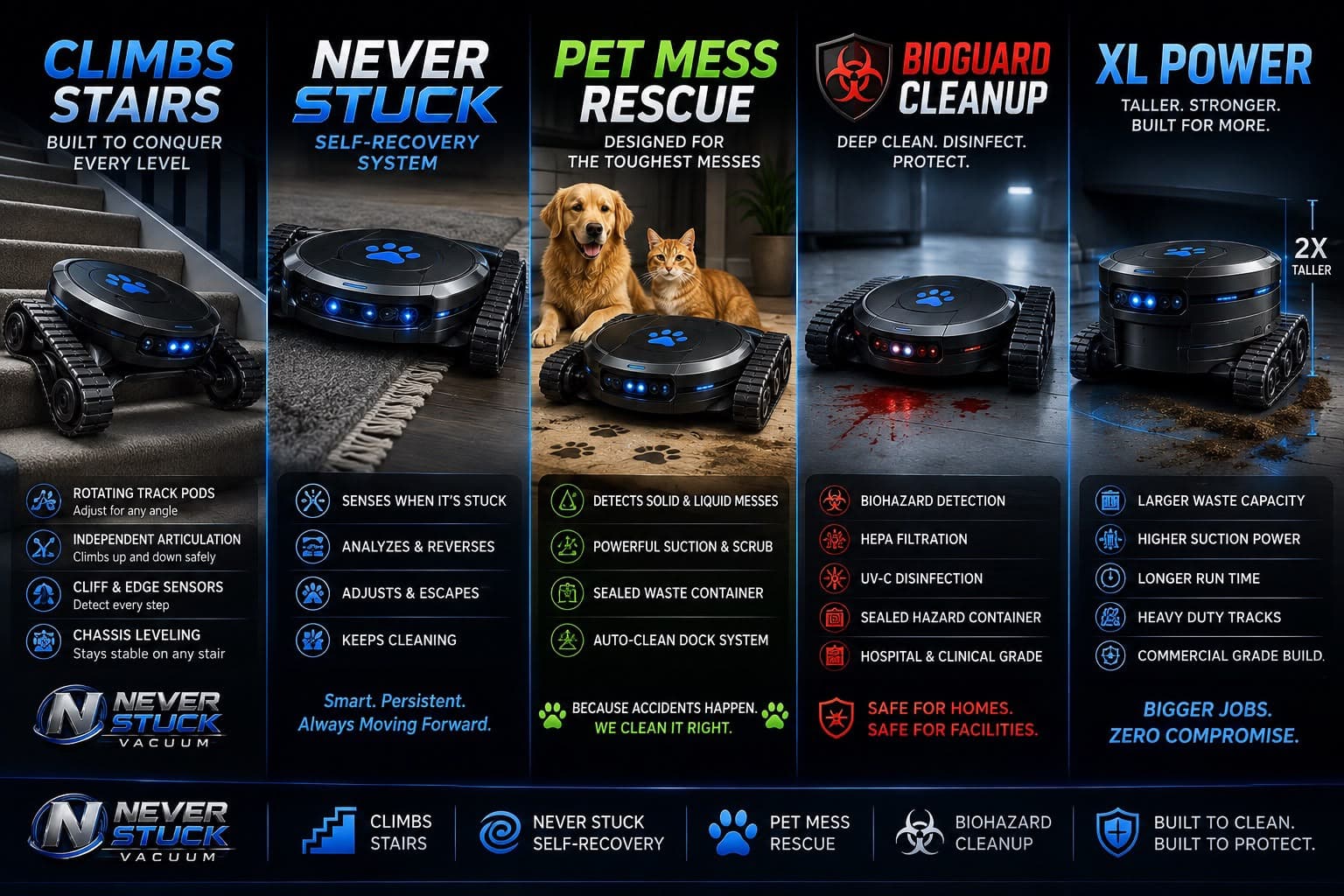
The core residential platform: routine vacuuming and mopping across hardwood, carpet, rugs and thresholds. Because it can move between floors on its own, the map it builds is the whole house rather than one level of it.
- Multi-floor mapping and room-by-room cleaning
- Rugs, cords, thresholds and floor transitions
- Stair permissions and no-go zones by floor
- XL
Never Stuck Vacuum XL
Large homes, heavy debris
More capacity. More house. Same stair-climbing mobility.
XL is deliberately taller and higher-volume than a conventional low-profile robot vacuum, built for large homes, multiple pets and heavy debris loads. The larger chassis is the point — it is what allows a substantially bigger debris container and a heavier duty cycle.
- Substantially larger removable debris container
- Taller chassis and reinforced track modules
- Built for a longer, harder duty cycle
- PET
Never Stuck Vacuum Pet Mess
Homes with pets
Detect the mess. Contain it. Deep clean it. Verify the result.
A household platform built for the messes a normal robot vacuum spreads across the room: pet feces, urine, vomit. It changes its own behaviour near a suspected mess instead of driving straight through it.
- Mess geofence halts normal brush behaviour nearby
- Solids collected into a sealed onboard cartridge
- Post-clean verification can command a second pass
- BIO
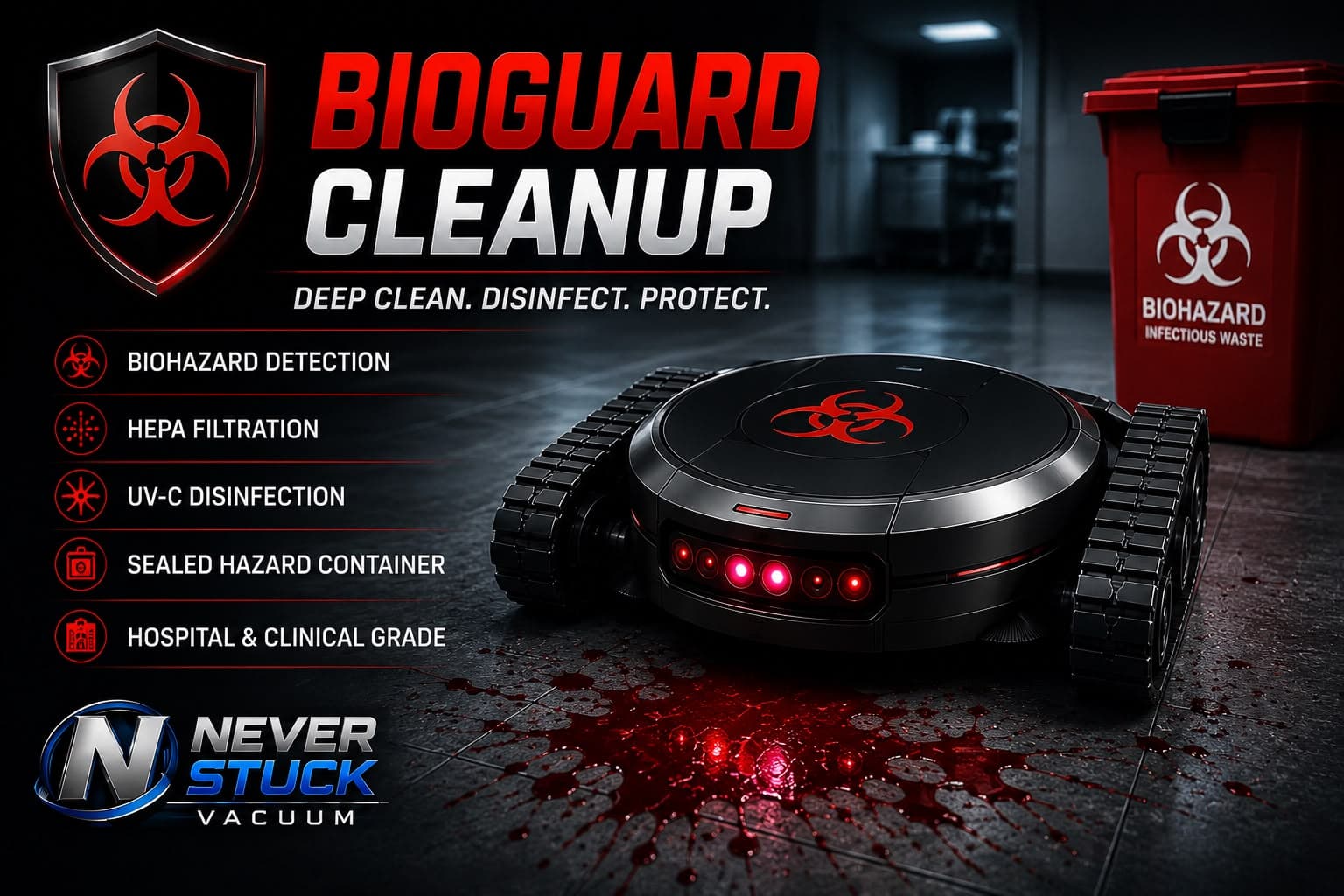
Never Stuck Vacuum BioGuard
Hospitals, clinics, care facilities
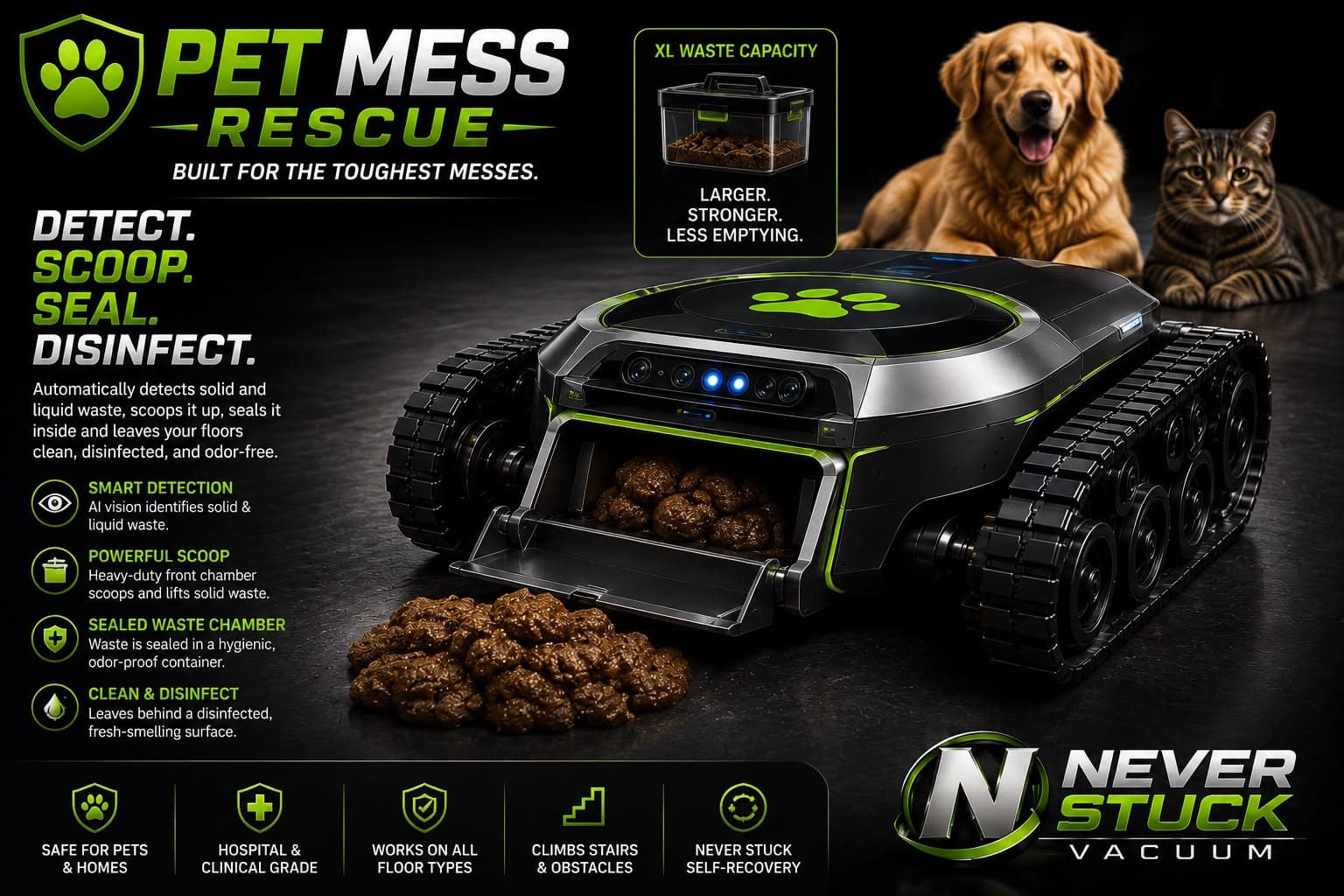
Purpose-built robotic cleanup for high-risk contaminated floors.
A separate specialty platform — not the household Pet Mess machine under another name. BioGuard is engineered around blood and body-fluid floor events in controlled institutional environments, with sealed containment and an auditable cleaning record.
- Sealed, replaceable containment and liners
- Controlled spray, absorb and extraction modules
- Event-level logging: area, cycle, consumables, result
- SAN
Never Stuck Vacuum Commercial Sanitation
Restrooms, gyms, hospitality, facilities
Scheduled and event-driven cleaning for the floors nobody wants.
The facilities use case: repeated urine and contaminated hard-floor cleanup around urinals, toilets, sinks and traffic lanes. It is a different buyer and a different cadence from residential pet cleanup, so it is treated as its own platform.
- Zone schedules plus incident-triggered dispatch
- Extraction, odour control and disinfectant application
- Cleaning logs, consumable alerts and fleet status
How it actually gets
up the stairs.
Detect
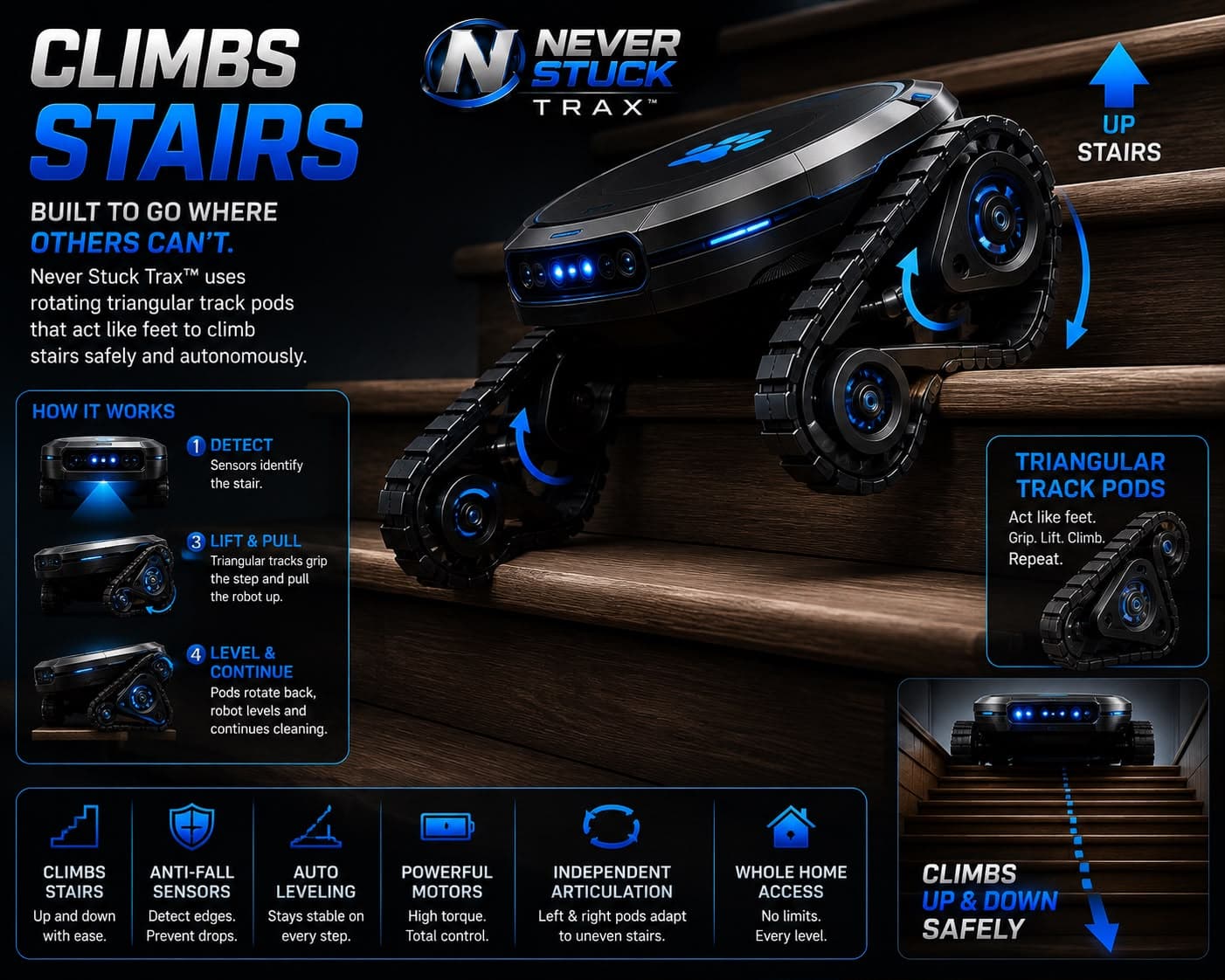
Sensor fusion — depth and RGB cameras, time-of-flight, infrared, cliff sensors and the IMU — classifies what is ahead as a staircase rather than a wall or a drop.
Align
The chassis squares itself to the riser. An angled approach is corrected before any climb is attempted, because a crooked entry is how a tracked machine gets wedged.
Articulate
The Never Stuck Trax™ track pods rotate out of flat-floor geometry into stair geometry. Left and right articulate independently, so an uneven or worn step does not force a retreat.
Engage
Continuous tread bites the riser and the tread nose. This is the part ordinary robot vacuums have no answer to: contact area, not wheel diameter, is what carries the machine upward.
Lift & level
Pitch, roll and centre of gravity are managed step by step. The chassis is kept level enough that the debris container stays sealed and the machine stays stable.
Re-level & repeat
On a landing the robot re-levels, re-reads the terrain and either continues to the next flight or returns to flat-floor geometry and resumes cleaning.
Coming back down
Descent is the harder half.
Gravity is helping on the way up and working against control on the way down. Descent is engineered as a braked, held, deliberate manoeuvre with its own confidence check — and a safety hierarchy that can stop, retreat or refuse the descent outright when traction, stability, battery state or a child or pet nearby makes it the wrong call.
Never-Stuck is a recovery system, not a stair trick.
Immobilisation signals
Track slip
Encoders turning, machine not moving.
Current spike
Motor load climbing against resistance.
No displacement
Odometry and the map disagree.
Chassis angle
IMU reports a pitch or roll that should not be there.
Staged escalation
Recovery is designed as a ladder, cheapest attempt first. Each rung is tried, evaluated and escalated from only if the machine is still not moving — so the common case resolves in a second or two and the heavy mechanical options stay in reserve.
- 01Reverse out
- 02Pivot in place
- 03Modulate track speed
- 04Change pod angle
- 05Torque pulse
- 06Re-level chassis
- 07Alternate approach
- 08Deploy recovery member
Last rung
When software recovery is not enough, the machine can change its own geometry.
A high-centred or wedged robot cannot drive its way out, however clever the routing is. The platform is engineered to carry deployable members — rods, struts, feet — that can lift, tilt, push or shift the chassis until the tracks find the floor again. It is a secondary mechanism by design, and every stuck event feeds back into how the robot approaches that spot next time.
More capacity. More house. Same stair-climbing mobility.
Conventional robot vacuums are short because they have to fit under furniture and because a small wheel cannot handle anything taller than a doorstop anyway. Tracks remove the second constraint — which frees the XL platform to be deliberately taller, carry a substantially larger removable debris container and run a heavier duty cycle before anyone has to empty anything.
Capacity, runtime and dimensions are still being finalised and are not published as figures until they are validated.
Proportional illustration only — no dimensions implied.
Detect the mess. Contain it.
Deep clean it. Verify the result.
- 01
Detect
A dedicated detection model looks for the mess patterns a household actually produces — feces, urine, vomit — rather than treating everything as debris.
- 02
Contain
A mess geofence goes up around the area. Normal brush behaviour stops before the robot reaches it, because the failure everyone has seen is a robot vacuum spreading a mess across three rooms.
- 03
Deep clean
Solids are collected into a sealed, removable onboard cartridge. Liquids are treated, agitated, extracted into a separate dirty-fluid tank, then rinsed and disinfected.
- 04
Verify
Vision and sensor checks assess the cleaned area afterwards. If it does not read as clean, the robot can order itself a second pass before it leaves.
Where the waste goes
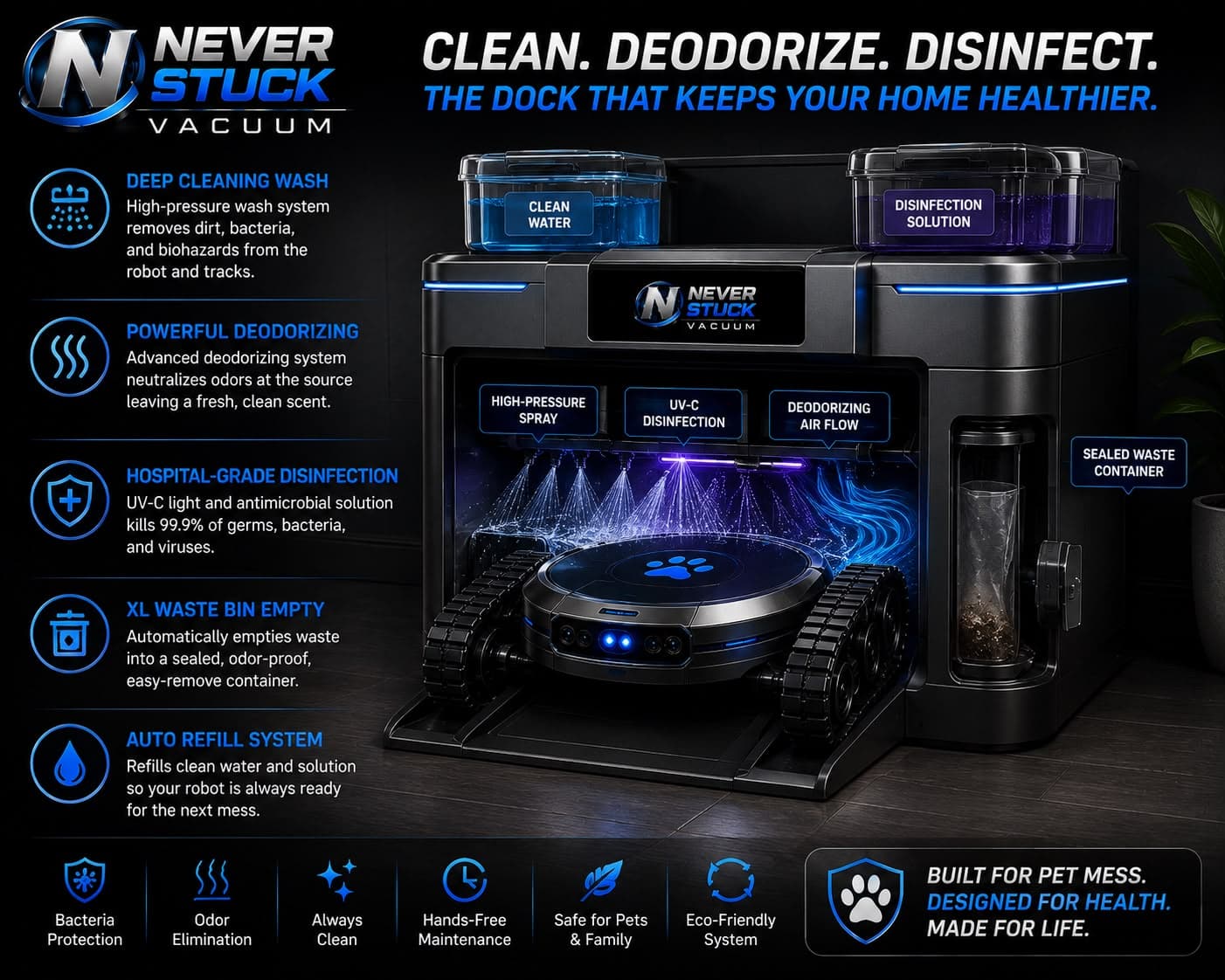
Collected solid waste stays sealed in its own removable cartridge, which a person lifts out and discards. The dock is a service station — it rinses, disinfects and dries the cleaning hardware and manages the fluid tanks. It is not, and is not designed to be, a place waste is stored.
Pet Mess is a household platform. It is a different machine from BioGuard, which is built for blood and institutional biohazard work — the two are not interchangeable and are not sold as one product.
Purpose-built robotic cleanup for high-risk contaminated floors.
Claims status
We do not publish disinfection percentages, pathogen kill rates, hospital-grade designations, or OSHA, EPA or FDA compliance claims for this platform. Regulatory and certification work is treated as pending until it is documented and independently substantiated — and until then, it will not appear on this site.
Event workflow
- 01
Isolate
The contaminated area is fenced off in the map before any cleaning hardware touches it.
- 02
Collect & extract
Controlled spray, absorb and extraction modules lift contaminated fluid off the floor rather than spreading it.
- 03
Contain
Everything collected goes into sealed, replaceable containment — disposable liners and cartridges where the workflow calls for it.
- 04
Disinfect
A treatment pass is applied to the isolated area under the facility's own chosen protocol and chemistry.
- 05
Verify
The area is re-assessed before the event is closed, and can be re-run.
- 06
Service
The robot returns to a dock designed to minimise how much of this an operator has to handle by hand.
Auditability
Every event leaves a record.
In an institution, a clean-up that was not logged effectively did not happen. The platform is architected so each response produces a structured record a facility can hand to whoever asks for it.
- Event ID
- BG-•••••
- Area / zone
- Recorded
- Start / end time
- Recorded
- Cleaning cycle
- Recorded
- Consumable status
- Recorded
- Verification result
- Recorded
The floors nobody volunteers for.
Zone schedules
Restrooms, locker rooms, entry lanes and wet areas each get their own cadence rather than one building-wide sweep.
Incident dispatch
A reported mess can send a robot to a specific zone now, instead of waiting for the next scheduled pass.
Odour and residue
Urine around urinals and toilets is a residue problem as much as a visible one — extraction and treatment are the point, not a wet mop pass.
Cleaning logs
Zone, time, cycle and consumable status recorded per pass, so facilities management can show the work was done.
Facility scheduling, dispatch and reporting are described here as platform capabilities under development. Nothing on this page should be read as a sanitation efficacy or compliance claim.
A robot that cleans this much has to be cleaned itself.
Standard dock
Home
Charge, empty and go. The everyday station: debris transfer, battery management and a status check before the next run.
XL service dock
XL
Sized for the larger chassis and its bigger removable container, with service access to the track modules and brush hardware.
Sanitation dock
Pet Mess
A wash station, not a bin: rinse jets, disinfectant flush, cleaning-head sanitation, dirty and clean tank servicing, and heated forced-air drying. Solid waste stays in its sealed cartridge for a person to remove.
Containment dock
BioGuard
Built around reducing operator contact — sealed consumable exchange, controlled fluid handling and service alerts tied to the event log.
Dock configurations are engineering concepts. Features such as enclosed UV-C treatment are described as optional where they can be implemented safely, and are not offered as a sanitisation claim.
A machine that climbs stairs has to know when not to.
It can refuse
The safety hierarchy sits above the cleaning logic. If confidence, traction, stability, battery state or geometry is wrong, the correct outcome is to stop, retreat or decline the manoeuvre — not to attempt it anyway.
Child and pet proximity
A staircase with someone on it is not a staircase the robot should be on. Proximity detection is engineered as a precondition of stair travel, not an afterthought.
Controlled descent
Descent is braked and held rather than rolled. Coming down is treated as the more demanding half of the manoeuvre, and is engineered accordingly.
Sealed containment
On the specialty platforms, what the robot collects stays sealed until a person deliberately removes it. Containment integrity is checked as part of the cycle.
Floor-safe tread
Non-marking, debris-shedding tread geometry. The tracks are designed for hardwood and finished floors, not to leave a record of where the robot has been.
Service alerts
Cartridges, tanks, brushes and track modules report their own state. A machine that needs attention says so rather than degrading quietly.
Tell us which floor you have a problem with.
Direct line
207-947-1999Mailing address
Never Stuck VacuumPO Box 52Detroit, ME 04929Who gets in touch
- Households waiting on a robot that can do the whole house
- Facilities, hospitality and gym operators
- Hospitals, clinics and care facilities
- Dealers, distributors and OEM licensing
- Robotics and testing partners